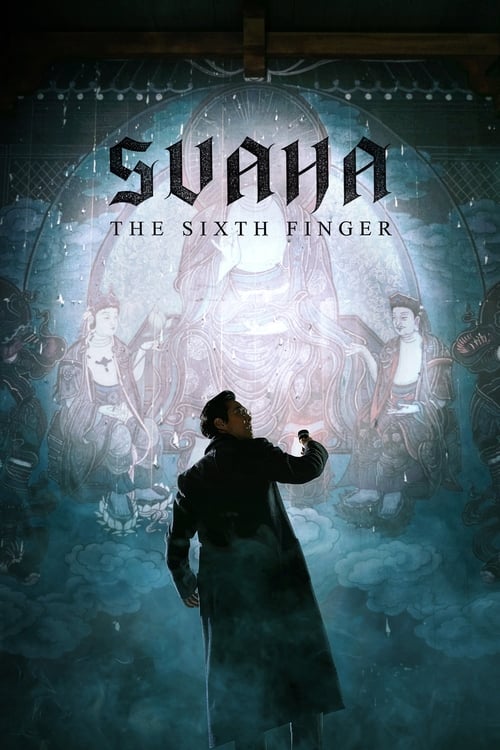
Svaha: The Sixth Finger (2019)
A religious mystery questioning the line between god and devil
by 10days1movie · Published 2026-11-18
| Type | Movie |
|---|---|
| Director | Jang Jae-hyun |
| Cast | Lee Jung-jae, Park Jung-min, Lee Jae-in |
| Release | 2019 |
| Genre | Horror, Mystery, Thriller, Crime |
| Runtime | 122min |
If telling good from evil were truly so clear, religion would not leave people so confused. Svaha bores into exactly that blurriness of the boundary. Following his debut The Priests, director Jang Jae-hyun again pulls in religion and the supernatural, but this time he chooses a far more complex and ambitious structure. The way several strands of story converge on a single point is intriguing, but because that ambition occasionally spills over into overreach, I end up settling on a rating of about ★3.5.
What it’s about — A pastor chasing a cult
Pastor Park (Lee Jung-jae) makes his living digging up and exposing the corruption of new religious groups. While investigating a mysterious group called Deer Mount, he discovers that its roots run far deeper and darker than he expected. Meanwhile, in a rural village, there is a girl who has lived hidden from her family since birth. Pastor Park’s pursuit, the mystery surrounding the group, and the girl’s secret flow along at different speeds before gradually merging into one larger picture. The film keeps tossing clues at the audience, making them gauge for themselves what the truth is.

Direction — A structure assembled like a puzzle
Svaha’s greatest feature is the way it handles information. Jang Jae-hyun does not show the story all at once but scatters the pieces one by one before fitting them together in the back half. The iconography of Buddhism and Christianity, the symbols of scripture, the meanings of numbers and names are laid down densely, keeping you turning the gears in your head throughout. This high-density construction is both a strength and a weakness. It richly rewards viewers who follow along with focus to the end, but the sheer volume of information can also feel scattered around the midpoint. The cold, dank visuals and restrained music create the uneasy air particular to a religious mystery.
Performance — A different weight for each character
Lee Jung-jae calmly plays a pastor wavering between faith and doubt. The contradiction of a man chasing the truth while his own belief is hollow is persuasively drawn. Impressively, he reveals the character’s fatigue and cynicism through the grain of expression and voice alone, with no large gestures. Park Jung-min appears as a young man belonging to the group and grows in presence as the back half unfolds. Above all, Lee Jae-in’s performance, close to a dual role, is striking. Even with few lines, she conjures a chilling tension simply by appearing on screen. The weight of the secret each character carries comes through clearly in the acting.

What the film says — Salvation and fear are one body
The question Svaha poses is not a simple one. The film relentlessly asks whether people seek god out of a longing for salvation or out of fear of death and the unknown. The moment the binary of good and evil, god and devil, is shaken, the characters reveal their most human faces. The premise that a being someone defined as absolute evil was in fact the weakest and most forsaken makes us look again at what we fear and what we cast out. The stance of refusing to declare carelessly what is sacred and what is sinful is what lifts this film beyond a simple horror.
Ratings & reception
The IMDb score is 6.3. Reactions that it is hard to grasp everything in one viewing because of the complex structure coexist with praise that there is all the more to chew on. As a work in which Jang Jae-hyun expanded his own occult universe following The Priests, it holds an important place in the lineage of his religious mysteries that later leads to Exhuma.

Verdict
Svaha is not an accommodating film. The density of information is high and the story’s strands are many, so once you miss something it is hard to catch up. But the satisfaction you get when you chase that complexity to the end is unmistakable. Among Korean films using religion as their subject, works that dig this deep are rare. For viewers who want clear answers it may be frustrating, but for those who know the pleasure of interpreting symbols and meanings, it is a film you watch two or three times over.
Recommended for
- Those who enjoy mysteries with plenty to interpret
- Those interested in Korean occult that weaves together religion and the supernatural
- Those who want to follow director Jang Jae-hyun’s universe
Comments